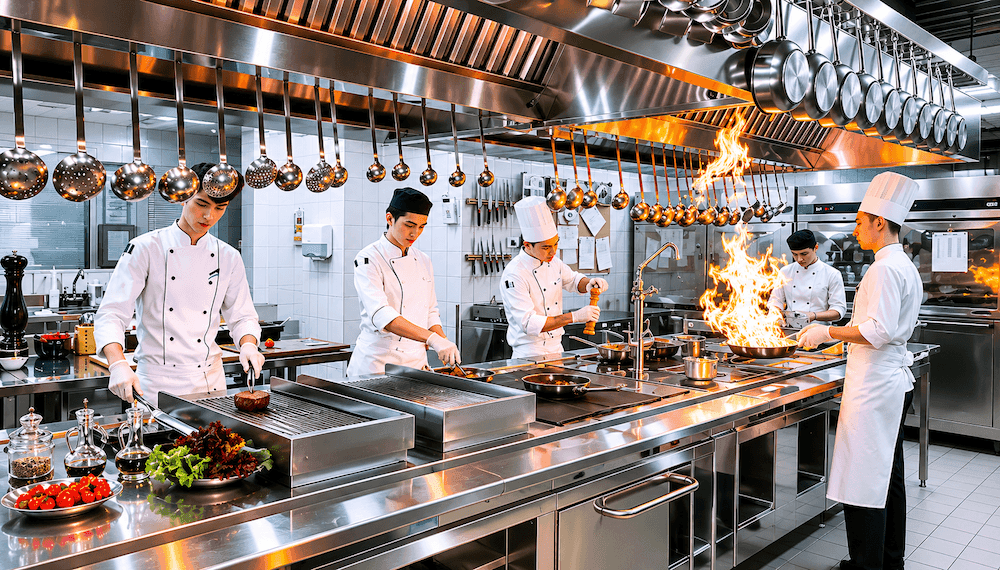
Your best bartender, your quickest waiter, your gun chef — promoted to run the floor. Nobody trained them to lead the team on it. MTA builds custom programs for venue managers, duty managers, head chefs and supervisors — practical, fast and built for service, not a business school.
Face-to-face at your venue · Online · Hybrid · Delivered across Australia · $299 per person
On-SiteDelivery at Your Venue
$299Per Person
90Min Modules
On-SiteDelivery at Your Venue
$299Per Person
90Min Modules
Certificate Included
90-Min Modules
Delivered Australia-Wide
WHS & Compliance Aware
What This Page Is About
Overview: MTA Training for Hospitality.
Hospitality is one of Australia's most demanding industries to manage in — and one of the most underserved when it comes to practical leadership development. Your duty managers, supervisors and head chefs are carrying enormous responsibility: service standards, safety, compliance, costs and people — often all at once, mid-service, with a young, casual team that turns over faster than any other sector.
Most of them were promoted because they were brilliant on the floor or in the kitchen. Almost none of them received formal management training before taking on their first direct report. The result shows up in your turnover numbers, your roster gaps, your guest reviews and your wage costs.
MTA builds custom training programs for hospitality businesses across Australia — from single-site cafes to multi-venue pub groups, hotels and restaurant brands. Every program starts with a DNA Audit of your specific challenges, service style and team structure. Then we build the modules that fix the actual problems — not a generic leadership curriculum that ignores what a Friday-night service actually looks like.
Available for individuals and groups. Self-paced for individual learners. Coach-led for individuals or groups — delivered face-to-face at your venue, online or hybrid. We cover all of Australia: Sydney, Melbourne, Brisbane, Perth, Adelaide, Canberra, Darwin, Hobart and regional tourism towns. We love to travel.
Is This For You?
Who Is This For.
MTA's hospitality training is built for people who manage other people in this industry — at any level of the operation.
Venue & Restaurant Managers
Duty Managers & Shift Leaders
Head Chefs & Sous Chefs
Front-of-House Supervisors
Newly Promoted Floor & Bar Staff
HR & L&D Teams in Hospitality Groups
Not sure if MTA is the right fit for your venue? Book a free 15-min chat — we'll ask the right questions and give you a straight answer.
The Real Problem
Hospitality Pain Points.
These are the management and leadership challenges MTA encounters in hospitalitybusinesses every week. If any of these feel familiar, you're not alone — and every one of them is fixable.
Leadership Transition · Venues & Restaurants
The Promoted Floor Star
Your best waiter, your fastest bartender — now they're the duty manager. They're brilliant in service but managing former workmates who know it. Nobody gave them a roadmap. Mates get away with things. Standards slip. The team knows exactly when they're being managed poorly, and on a casual roster, they just stop picking up shifts.
MTA Fix →From Peer to Manager + Accountability That Sticks — delivered face-to-face at your venue. Gives newly promoted duty managers and floor supervisors the people management tools they should have received before the promotion.
Leadership Under Pressure · Peak Service Environments
Falling Apart Under Pressure
It's a full book, a slammed bar and two no-shows. The manager loses the room — barks orders, freezes, or disappears into the weeds doing the work themselves instead of leading. The team feeds off that energy. Service suffers. Guests notice. And the post-shift debrief turns into a blame session instead of a fix.
MTA Fix →Team Communication That Sticks — gives supervisors and managers a communication framework that works when service goes sideways. Not theory — a repeatable briefing and debrief format they can use at the next service.
Workplace Health & Safety · Hospitality Venues
Burnout, Bullying & the Compliance Blind Spot
Long hours, high heat, young staff and old-school kitchen culture. 'That's just hospo' gets said a lot — until someone makes a complaint, a Fair Work claim lands, or a great young chef walks out for good. Psychosocial hazards are now squarely a WHS obligation, and most venue managers have never been shown what good looks like.
MTA Fix →WHS for Managers + Building a Psychologically Safe Team — two modules that work together. One gives your managers their legal obligations under WHS law. The other builds the culture where people feel safe enough to speak up — before it becomes a complaint or a claim.
Retention · Venue & Floor Teams
The Revolving Door
Hospitality has the highest turnover of any Australian industry — and you're feeling it. You're forever recruiting, inducting and re-training, and every walkout lands back on the roster as a gap someone has to cover. The exit reasons all point the same way: 'the manager.' The real problem is sitting one level above the person who just quit.
MTA Fix →Coaching Your Team + Running Effective 1-on-1s — the two highest-impact modules for manager retention. When people feel developed, they stay. When they feel invisible, they leave. These modules fix that dynamic at the supervisor level, where it matters most.
Operations · Wage Cost & Roster Management
Rosters, Wage Costs & the Wrong Fix
Wage cost is creeping over target and the manager's answer is to cut shifts — then service drops, the team gets stretched, and the good ones leave. The real issue often isn't the headcount; it's that the people on the roster aren't being led or deployed well. Cutting hours when the problem is leadership just makes everything worse.
MTA Fix →Book a free DNA Audit conversation — a free conversation to help you identify whether the problem is truly a headcount issue or a leadership capability gap that training can close. No obligation. Straight advice.
Team Dynamics · Front-of-House & Kitchen Teams
Front of House vs the Kitchen
The age-old hospitality divide: floor blames kitchen, kitchen blames floor. Dockets, timing, specials, complaints — every busy night reopens the same war. The manager is caught in the middle with no tools to bridge it, so they pick a side or avoid it entirely, and the tension bleeds straight into the guest experience.
MTA Fix →Team Communication That Sticks + Difficult Conversations — gives supervisors a communication framework that bridges the floor-kitchen divide and the language to resolve friction before it bleeds into the guest experience.
What Poor Leadership Actually Costs
$3.5k+
Typical cost to recruit, onboard and train a single replacement hospitality worker — Industry Workforce Estimates
#1
Hospitality records the highest staff turnover of any Australian industry — ABS / Industry Data
57%
Of employees who leave point to their manager — not the venue — as the reason — Workforce Research
What This Training Solves
The Problem This Page Solves.
Some venues genuinely can't find enough staff — and no amount of management training fixes a real labour shortage. But here's what MTA sees just as often: venues with enough people who aren't performing or staying like they should. The talent is there. The energy is there. What's missing is the layer of leadership that turns a group of casuals into a team that delivers a consistent guest experience — calmly, profitably and without the manager doing everyone's job. When the problem is who you can hire, training isn't the answer. When the problem is how they're being led, it usually is.
Real Scenario — Multi-Venue Pub Group, NSW
A three-venue pub group was haemorrhaging floor staff — rosters were never full and the same gaps appeared every weekend. Exit chats pointed to 'duty managers who play favourites.' The ops manager had tried staff drinks and a new incentive scheme. Nothing stuck. MTA ran a DNA Audit, identified four duty managers as the source of most of the churn, and built a custom 4-module program just for them. Within a season, the worst-performing venue's turnover dropped sharply and weekend rosters were filling a week ahead. The managers didn't change their personalities — they changed their behaviours.
Real Scenario — Restaurant Group, Victoria
A well-reviewed restaurant kept losing promising young chefs after a few months. The food was excellent; the kitchen culture was not. The head chef was technically world-class but ran the pass on fear. MTA's Difficult Conversations and Psychological Safety modules, delivered between services on quiet weekday afternoons, changed how the head chef and senior staff spoke to the brigade. Six months later, the kitchen had its first full season with no chef resignations — and the food got better, not worse.
What Changes After Training
Hospitality-Specific Training Outcomes.
These are the specific, measurable outcomes MTA programs produce in hospitality environments. Not 'improved awareness' — actual behavioural shifts that show up in your roster stability, your reviews and your wage-to-revenue numbers.
Managers lead calmly under pressureA full book stops being a crisis. Managers brief the team, work the room and hold standards when it gets loud — instead of disappearing into the weeds.
Accountability conversations actually happenDuty managers and supervisors address slipping standards before they become a guest complaint — calmly, clearly and without playing favourites with mates.
Casual staff want to keep picking up shiftsWhen people feel led and developed, they stay on the roster. The link between manager quality and a venue that staffs itself is real and measurable.
Front of house and kitchen pull togetherShared standards and a way to resolve friction mean the floor-versus-kitchen war stops bleeding into the guest experience.
Newly promoted staff lead with confidenceThe jump from floor or bar to duty manager is handled on purpose — not left to sink-or-swim on a Friday night.
Wellbeing and compliance are built inManagers understand psychosocial WHS obligations and run a venue where pressure doesn't tip into burnout, bullying or a Fair Work claim.
Every MTA module ends with a Monday Morning Action — one specific, named commitment each participant applies before the week is out. In a venue, that might be the first proper pre-service brief a duty manager has ever run, or the first accountability chat they've had without it turning into a blow-up. That's where the change starts.
Start Here · Built for Hospitality
Mini Foundations Program: LEADING IN HOSPITALITY.
Not sure which modules to start with? Leading in Hospitality bundles the four essential modules every hospitality leader should work through — chosen for you, so there’s no decision to agonise over. Take it self-paced, or work through all four live with an MTA coach.
Reality → People → Pressure → Culture
The 4 Foundation Modules · 90 Min Each · Certificate Included
The Service RealityIND05·PROG01·MOD01 · Foundation
Managing the ShiftIND05·PROG01·MOD02 · Skill-Build
When Service Gets HardIND05·PROG01·MOD03 · Application
The Culture Behind the CounterIND05·PROG01·MOD04 · Integration
Pricing shown is per individual. Individual training is delivered self-paced online, or online with a live coach — face-to-face and hybrid delivery are available for teams only.
Self-Paced · Online · Instant Access
$999+ GST
Save $197 vs buying the modules individually
Immediate access in your account portal. Work through all four modules online, at your own pace — start the minute you enrol.
Foundations Program modules are locked — the core four can’t be swapped out. Stack extra modules on top → from anywhere in the full library.
Modules Best Suited to Hospitality
Recommended Modules.
These modules have the highest impact in hospitality environments based on MTA's work with Australian venues, restaurants, cafes, pubs, clubs and hotels. Mix with any other module across all 9 categories →
Workplace Compliance
Workplace Investigations
Workplace Investigations — a practical 90 minutes module for Australian managers and team leaders. Certificate of completion included.
MTA builds industry-specific programs for teams across every major Australian industry. Every program is customised — your sector, your challenges, your language.
We come to you. MTA delivers face-to-face management training on-site in every state and territory — plus the regional hubs in between. Online and hybrid options keep split shifts and multi-site teams covered.
Real questions about hospitality training.Straight answers.
Managing a hospitality team requires calm leadership under pressure, crystal-clear communication during service and consistent standards across a high-turnover, often casual workforce. The challenge is that most venue managers and supervisors were promoted because they were brilliant on the floor or in the kitchen — not because they were trained to manage people. That's the gap MTA closes. Our programs are built specifically for this context: practical, fast and immediately applicable between services — not in a conference room somewhere.
Duty managers, venue managers and head chefs typically need: leading calmly under pressure, accountability and performance management of casual teams, rostering and delegation, service-standard coaching, conflict resolution and the ability to have difficult conversations without losing the person. MTA builds custom programs around your specific gaps — not a generic list of competencies that ignores what a Friday night actually looks like.
Name the specific behaviour. Describe the impact on the guest experience and the team. Set a clear expectation. Then follow through — every time. The mistake most hospitality managers make is avoiding the conversation because 'we were slammed' and hoping it sorts itself out. It rarely does. MTA's Accountability That Sticks module is built for exactly this fast-moving context — with hospitality examples throughout.
Hospitality employers must meet obligations under the Work Health and Safety Act 2011, Fair Work and award conditions, plus state-based RSA and food-safety requirements. From December 2025, psychosocial hazards — including poor management behaviours like excessive pressure, bullying and lack of support — are explicitly listed as WHS risks that must be controlled. With a young, casual workforce, poor leadership isn't just a people problem; it's a compliance risk. MTA's WHS modules are built around Australian hospitality obligations specifically.
The research is consistent: 57% of employees leave because of their manager, not the company — and hospitality already runs the highest turnover of any Australian industry. Every walkout means recruiting, inducting and re-training, and lands back on the roster as a gap. The single most effective lever is improving frontline manager quality. When your duty managers and supervisors lead well — fairly, clearly and with genuine investment in their team — casuals keep picking up shifts and good people stay.
Yes. Face-to-face delivery is available at your site — restaurant, cafe, pub, club, hotel or function venue, anywhere in Australia. For on-site delivery, a minimum of 4 modules is required, which equals one focused training day (approximately 6 hours). For teams that can't spare a full day, or for rotating rosters and multi-site groups, we deliver online or hybrid — where the 90-minute module format fits neatly between services or into a quiet weekday morning. We come to you either way.
It's specific. Every MTA program starts with a DNA Audit of your business — your venue type, your service style, your roster structure and your actual challenges. Real hospitality scenarios, front-of-house and back-of-house examples and Australian compliance requirements are built into the content. It's not American business-school content repackaged for Australia. It's built here, for here, with your venue's realities at the centre of it.
A duty manager runs the floor during a shift — opening, closing, leading the team and solving problems in real time. A venue manager carries broader responsibility: rostering, budgets, compliance, recruitment and the overall performance of the site. Both roles require leadership training — but the content and depth differ. MTA can build separate programs for each level of your venue or group, targeting the specific gaps that show up at each tier.
Self-paced individual access starts from $299 per person per module + GST. That's the entry point for a single individual working through a module at their own pace. For group pricing, contact us for a quote — we'll give you a straight number, not a ballpark. Most hospitality businesses find the group investment pays for itself fast when measured against reduced turnover and recruitment costs.
Your Next Step
YOUR VENUE. YOUR TEAM. YOUR PROGRAM.
MTA builds training programs around your hospitality operation — not a generic curriculum. Tell us your challenges and we'll map the modules. 15 minutes. No obligation.